Showing posts with label Ireland. Show all posts

Wednesday, May 26, 2010

Has It Been That Long


When I traveled to Ireland with friends, several years ago now, I went looking through shops trying to find medallions or medals that I could convert to jewelry designs, as an inspiration. I wasn't able to find any, except in one shop window I peeked through but the shop was not open at the time and I couldn't ever get into it.

With the Memorial Day holiday in the US coming up, I guess I'm thinking again about medallions and medals, so I made this piece to resemble an antique emblem that might have passed down through the generations.

There's a sailing ship in the center, with the crown on top and thistles on the sides and bottom. I can't read all the latin inscription, but I am thinking it's something inspirational.


I think it's time for a celebration with a giveaway, I'll think of what I can come up with. What are we celebrating?

50,000 hits on the blog was reached yesterday.

That's amazing to me.

I found out the blog is ranked #9 on a Jewelry Wiki site.
Astounding.

And the Etsy shop is teetering on the edge of 1000 sales in the one shop, and 900 sales in the other shop. When I add that together, it's almost scary to know I've created that many items, much less that someone is enjoying them and creating with them.

So keep an eye peeled later in the week for a giveaway - as a thank you! and celebration.

None of it would have been possible without YOU!

Wednesday, March 10, 2010

Palace of London Key to Travel


I like images with advertising art, they always seem nostalgic to me. So I created this oval resin piece with a hotel advertising label in it, bright red, and set it in an oval ornate pewter frame.

I guess I have travel on my mind, it's almost time to start packing for Artfest. I can't wait!


This red oval has the words "PALACE HOTEL LONDON" and "Central to Everywhere" in it, it's translucent so light shines through when you hold it up to a light.

The attached key reminds me of some of the hotels and B&B I stayed in during the trip to Scotland.

It looks so ancient!

Wednesday, February 10, 2010

Lovebirds Shielding


Here's another example I just finished, of creating the metal collages. I used a shield shaped pewter medallion and added a detailed emblem of the lovebirds.

They're pretty fanciful, I know. They remind me of my idea of antique medals and medallions, the kind I was searching for on the trip to Ireland but couldn't find the real thing during the trip.

It looks sort of sentimental to me, like a Victorian love charm or memento mori piece.


Maybe I'll try engraving some sweet messages on the backs of some of these. You know, like the flowery initials and names you see on some vintage pieces, on the reverse side.


And they're still very lightweight this way, I'm very pleased.

Now, if the weather will warm up a bit, I'll turn to taking a cast off the authentic french medal, and see about using it on something similar.

I can't wait! Can we have spring now, please? Instead of all this snow...

Monday, October 26, 2009

Brilliant


Some of you may remember, a few years back I took a memorable trip to Scotland with friends. Excellent!

I did spend the end of the trip in Glasgow, before the airplane trip back to the midwest.


I enjoyed the ornate, decorative look to things, and the way the architecture looks back to very vintage times.

Simple and luxurious.

I promised myself when I came back that I'd try to continue some of the activities from the trip.

A cocktail in the evening.

Dinner by candlelight in small glass tea light holders.

A sip of tea in the afternoons.


Sometimes I remember, sometimes I get too busy and I forget or postpone them.

Travel broadens. It changes things.

How to think about the speed of life, the things that are important.

Saturday, October 24, 2009

Crosses and Writing From History


I have a book I brought back from the trip to Ireland. It's all about the Book of Kells.

I was able to see actual pages of the real thing, when visiting the library of Trinity College.


So I made a few small cross shapes, with writing that looks like a medieval script.

The other side has a linear drawing, and some have writing from the Book of Kells.

I like celtic designs, and things that look ancient. Usually I make just one at a time, but I decided to make four.

In different colors.


Might be fun for holiday ornaments, or to make a bookmark for a special book. Starting to think about the holidays, are you?

I am. I feel pressured already - I'm behind!

Sunday, October 4, 2009

Artifacts of Life, Newly Uncovered


I love old carved bone charms. These have markings from the Book of Kells. The old manuscripts.

Ancient looking, with spiritual overtones.


I made this pair of earrings with some of the lampwork beads that Sue sent me. I love the way the glass shines and the charms are matte, the contrast. Warm and cool, the glass chilly in the air, the charms shiny and slick.

Simple brass wire and gunmetal earwires. These are lightweight to wear.

They remind me of something found in an archeological dig. Artifacts.

~~~~~~~~~~~~~~~~~
Well, I keep finding things that don't turn on when you push the ON button.

At first I thought we lost the microwave, but we found the RE-SET button.

The computer can't find the printer right now. I keep pointing and saying "see? it's right there, beside you" but so far it doesn't believe me. It may be something with the cable. At least, I hope so.

I found an old clock radio and put it into the studio for some music, since the old amplifier doesn't turn on any more, and neither does the old boombox with the CD player. And working in silence wasn't any fun.

Thankfully the kiln seems fine. I may fire it up this afternoon just to be sure. It's programmable, so it does have digital circuits.

It's like the times during ice storms when the electricity goes off, you realize how much you depend on it every day.

But we did test the furnace, and it seems all right. Thankfully, because it was 40 degrees F last night. Not the time you want your furnace thermostat messed up!

Thanks for your patience and for all the kind words. This will be over soon, I hope!

Friday, August 21, 2009

Souvenirs of Armchair Travels


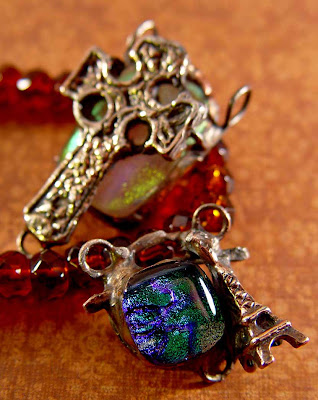
Last weekend I ground the edges and fire polished some faux gemstones in the kiln, to combine with some cast pewter emblems. I wanted the results to look like travel souvenirs from long, long ago.

Back before the turn of the century, the well-to-do of America and Europe went on tours, either with a travel scheduling company or with a well-worn travel guidebook in hand.

In those times travel was much slower, with steam ships and trains making the most of the travel along with carriages, camels and mules.

There are many well-written memoirs of those ladies and gentlemen and postcards sent back to friends from places that seemed exotic and foreign.


These two glass and pewter pieces are meant to resemble things that may have been brought back from such a travel tour. The ancient-looking celtic cross sits on top of a beautiful shimmery golden dichroic glass stone that glistens and changes color in the light. The celtic cross looks worn and old, possibly from some Irish monastery or treasuretrove.


The french Eiffel Tower charm sits beside a beautiful blue-green dichroic fused glass stone. It reminds me of the souvenirs available during the Paris World's Fair when the Eiffel Tower was opened, it has that Art Deco kind of feeling with the round settings.


There's another fused glass faux gemstone with a bright shimmery blue stone and a fleur de lys that I like in the shop now, too. My mind wanders and my hands follow, and out come these faux artifacts! Both one of a kind ... with a special feeling for travel.

Wednesday, July 22, 2009

Angel Face


When I traveled to Ireland and went to some of the ornate churches, in the churchyard there were many beautifully carved wings and faces in the decorations of the buildings.

This little emblem reminds me of those angels, their tiny faces looking down from columns and across from doorways.

And also decorative ornaments on french renaissance furniture, the crowns and wings speaking of the politics and religion of the time.


Like little girl's furniture, painted white with carved angels on the headboards and the crowns of the moulding decorating the closet doors.

Faux-tiques - reminders of the real antiques, created to evoke and capture a mood.


The reverse side has french script writing, like music notations, elegant yet faded in a light burgundy lavender color.

Monday, March 23, 2009

Green Garden Crown


This design has been waiting to be finished, I probably should have done it before Saint Patrick's day. I just didn't get it pulled all together until recently.


The front of it is cast in resin, from that last batch I showed that had a glint of golden color to it, but tinted with a green color.


The reverse side is polymer clay, and the bead is quite light even though it's substantial, because it's hollow inside.


It reminds me of the designs in wrought iron gates, with a mossy finish from being out in the garden. It reminds me of the castle garden, of the place I stayed on the trip to Ireland, when we were near the coast. That rustic ancient feeling, still moist from a dewy morning.

There are more photos at the Etsy shop, if you want to take a peek.

Monday, February 23, 2009

Winged Words


Here's the second necklace I finished in the last few days. I showed the crowned, winged face focal bead a while back, and decided to add the word 'W-I-N-G-S' as a dangle. When I started putting it together I wasn't thinking about Mardi Gras, with Fat Tuesday coming up. But the vintage freshwater pearls and the brass prayer box started me down a path of expressing emblems for the spring spiritual season.


The main focal piece reminds of of old cast iron decorations on the fronts of buildings, that get painted and weatherworn, with the dark metal showing through the worn-off color. The hook is handmade brass, attached to a bead that looks like a piece broken from a cathedral stone trim.


The image reminds me of some of the cemetary stones I saw in Ireland and Scotland, with the wings and crowns on them. The feeling of being out in the weather and worn, and probably touched by many hands over time.

This special little necklace is in the Etsy shop, if you want to see more photos.

Thursday, January 1, 2009

Celtic Annum Chant - New Year


Listen and Read - History on Tap

Chants were learned by viva voce, orally learned through example. The notation is a graphic form of signs, called neumes. They are based on a musical gesture, and eventually changed to become the five-line staff we know know for music notation, first used in the 16th century.


Traditionally sung by choirs of men and boys in churches, or women and men of religious orders in their chapels, there are Gregorian and Ambrosian chants, and a Mozarabic chant used in Spain.

Gregorian chant was promoted across Europe by Charlemagne, when he became Holy Roman Emperor, and spread as far as Scandinavia, Iceland and Finland.

There was resistence in displacing the Celtic chant in Brittany, the British Isles and Ireland with Gregorian chant until the 9th century.

Irish monks formed monasteries throughout Europe such as the Abbey of St. Gall in Switzerland.

To hear a chant
sung by
Rick Dechance in German Latin, go to this link.


READING LIST -
RECOMMENDATIONS
FOR WINTER NIGHTS

~~~~~~~~~~

If you are interested in history, the Dark Ages or Ireland, and looking for a good non-fiction holiday read while you are in front of the yule fire sipping hot toddies, check out 'How
the Irish Saved Civilization' by Thomas Cahill.

He tells the tale, all historically true, how Irish monks maintained the records of Western Civilization to prevent their total loss and preserve much of western culture. This is the first book in a seven book series by Cahill on Western history, called the Hinges of History series. (256 pages, published first in Feb. 2996)


~~~~~~~~~~


If you're in the mood for something lighter and more in fiction, try any of the Sister Fidelma Mystery series by Peter Tremayne. I suggest 'The Haunted Abbot: A Mystery of Ancient Ireland' or 'The Subtle Serpent: A Celtic Mystery'.


He tells the story of an irish woman,
Sister Fidelma, who is a both a 7th
century nun and a dalaigh (or advocate)
authorized to practice law in the courts of Ireland.

There are celtic political intrigues, historical details and a murder mystery to be solved. The historical background includes sites of geographical details in Ireland, castles such as Cashel and hills of renown that still exist today.

Peter Tremayne is a pen name for the Celtic schloar Peter Berresford Ellis, a born storyteller with the historical knowledge to keep it true while making it interesting reading. He is still writing the series about Sister Fidelma, and you may be able to find these books at the public library - if you do, check them all out and settle down for a long, good read.

~~~~~~~~~~
Hot toddy optional but highly recommended.
~~~~~~~~~~~~~

Happy New Year -
Sales going on in both shops - grab some year end specials and start off 2009 with me!

Sunday, December 21, 2008

Overhead and Underfoot


Converting Floor Mosaics to Quilts in Style


In Europe, there are floors in cathedrals that are mosaics. Also in Barcelona, in the Ensanche area, there are patterns dating from 1859, in private homes and public buildings both. The geometric shapes feature diamonds, triangles squares and rectangles.

In Islamic art there are no representations of the figure, so many decorative areas in homes and religious buildings have geometric repetitive designs.

Many of these styles of ceramic tiling have been converted to patterns for use in quilts.

Hand dyed fabrics that resemble stones are sometimes used in these quilts, to make them look even more like mosaic tiles.


Many European travelers take photos of these floors to be able to convert them using graph paper, to create a new pattern for use to replicate these traditional stone tile designs in fabric.

I like to make my hand dyed fabrics look like marbled stones, but haven't made a quilt using them in this style. I think it would be neat to do, though.

Islamic patterns, tiles and brickwork and roman mosaics have inspired many beautiful quilt patterns.


Christine Porter is a quilt maker who has interpreted victorian tiles found in England into quilt designs. Her book 'Viva Venezia' shows quilt patterns inspired by floor tile designs from Venice, made using marbled batik fabrics to resemble the marble tiles in the original floor pattern.

This is a pattern from St. Andrew's Cathedral in Inverness, Scotland, pinwheels with an intricate cream pattern, corner tiles on the edge in blue and terracotta.

Byzantine churches also had mosaic floors that would be useful designs for fiber art projects, like this one from the Capella Palatina in Palermo, Sicily.
I'm working on some ornaments that are based on quilt patterns. When I get some finished I'll post some photos here.

Thursday, December 18, 2008

Tread the Stones of History


A Walking Tour into The Past


In France, in the cathedrale de Notre-Dame, Chartres, there's a labyrinth in the floor in black and white stone, in the middle of the nave centered between the fourth and fifth bays from the west end.

It's a circular labyrinth, oriented toward the westerly direction, with an overall diameter of 41 feet, and a 5 foot 6 inch circular pattern in the center of the design. It's one of the last surviving original labyrinths of its kind, with a six petal rosette in the center representing formation and transformation.

And symbolising the six aspects or elements of creation - mineral, vegetable, animal, human, angelic, unconscious or mysterious.

When I was very young I lived near Paris, and visited Chartres. I'm sure I didn't walk the labyrinth then, and I wish I could walk it now as an adult - it is the most-walked labyrinth in the world.


It's believed that in the early 13th century those who couldn't make a pilgrimage to Jersualem during the Crusades created the 11-circuit labyrinth to provide a pilgrimage inside the cathedral itself, with an odd number of pathways to follow.


Labyrinths have been an ancient symbol in many different cultures for thousands of years. It can be a metaphor for life, walking a single path into the center and following the same path out to the beginning, in silence and meditation. The romans and those living in Crete also had this design in their cultures. Romans buildings have pavement labyrinths in the floors of bathhouses, villas and tombs, although they are too small for walking.

Labyrinths and mazes date back as far as 3,200 years on pottery, cast in stones and woven into baskets. In the southwestern United States there is a design called 'the man in the maze' that you find on pottery designs, especially blackware pottery. These designs are seen often with the Hopi and the Navajo, in jewelry and baskets.

Each line in the maze symbolizes a time in life - birth, childhood, puberty, marriage and death in a continuous line as the journey of life unfolds. As the journey continues, the traveler gains knowledge, strength and understanding.


The Celts described the labyrinth as the 'Never Ending Circle' similar to the stone and bronze age cup-and-rings Pictish carvings in the Highland rocks of Scotland. I visited some of them myself on a trip near Lochgilphead.

In Edinburgh there is a labyrinth in one corner of George Square Gardens that's based on the one in Chartres Cathedral. I missed seeing and walking that one, when I visited Edinburgh years ago.

You may have a labyrinth near you now, in a church or park. They are, somewhat surprisingly, found in many places in America and Canada. Some are indoors, painted on floors, others are outdoors in gardens.

And the difference between a labyrinth and a maze is very important. Do you know the difference?

Monday, December 8, 2008

Cross and Crown


On the trip to Ireland several years ago, my friends and I visited the Rock of Cashel. There's an ancient celtic style cross there, with the characteristic circular pattern around the arms of the cross.

It's a high cross, a traditional latin cross with a circle enclosing the arms and uprights of the cross.

For more history about the origin and meaning of the celtic cross images check out the exhibit
with many examples.

When I travel, I take photographs but I also do quick sketches and watercolor washed pages in a small drawing book. A page from my sketchbook has this simple line drawing of another ornate celtic cross.

Many crosses of this type are markers, historical monuments. Others I've seen in cemetaries are markers and memorials of people and families.

In 2005, a celtic cross monument was erected in honor of the irish immigrants to Saint Louis, Missouri, where I currently live. Saint Louis is a very old town, with many historical areas and stories from the original settling of the western part of this country.

Another benefit of the large Irish population in Saint Louis is the many excellent Irish pubs in the area!

I recently made three little pendants in the spirit of the ancient crosses. There are several styles, this one is the celtic cross with four circles, one surrounding each of the upright and cross arms. I'm doing some research on this configuration, to see if it has a special meaning or interpretation. Later I'll show the crown and some of the other crosses I created as replicas of artifacts.

It looks very timeworn and ancient, with great details. It has an opening from top to bottom, for wire or cord to pass through.

It would be great worn as jewelry, or used as a decoration. It reminds me of the worn and ancient celtic crosses standing out in the open on the hills in Ireland.

Or on the open prairie in the midwest, in downtown Saint Louis, Missouri.

Monday, October 20, 2008

Baby Blue Sweet Cheeks


Several artists whose work I admire have recently been creating some beautiful designs, using doll heads and bodies that have been rescued from a German doll factory. They are rejected porcelain doll parts, apparently buried near the factory, but being uncovered now. Some lovely pieces of jewelry have been created around those recovered faces, bodies and other parts.

I wanted to make something in that spirit, but different enough to have a unique look and feeling.

This little focal bead is meant to replicate the look of an italian ceramic piece, possibly from a wall mosaic or in the stairway of a chapel. You know how old things that are touched by generations of hands or feet get a certain patina, hand rubbed?

I remember during the trip to Ireland during a tour of one of the restored castles, how the treads of the stairs had an indention in the middle of the stone step. That was caused by generations of feet going up and down those circular stairs, until after so much time and use the steps were worn away.

I wanted this little faux ceramic replica to look as though many hands had touched it, shoulders had rubbed it over the ages. With crackled edges and an almost verdigris patina to it.

Remember some weeks ago - all those posts about my challenge in getting a nice blue or blue-green color? I'm very pleased with these results on the bird's egg blue on this bead.

It would be fun to combine this bead with some turquoise beads, or some hand dyed blue green costume pearls rosary wrapped with darkened wire.

It reminds me of a little cherub or angel face, with a chantilly lace head scarf wrapped around it.

I didn't want to be too close in copying the vintage german porcelain dolls, and I think I managed to do something quite different but with the same feeling.

What do you think?

Wednesday, October 15, 2008

Signs and Markers

When they take you on the tour of the library at Trinity College, where the famous Book of Kells is preserved and displayed, there is no photography allowed, to protect the images and calligraphy in the book. Only a few pages at a time are visible.

You peer through the protective glass covering and view the parchment vellum pages, decorated and illustrated so many ages ago, and try to imagine what life was like at that time using goose feather quills and having to make your own ink from oak gall.


This photo is two pages from my sketchbook for that trip. Because no photography was allowed I would sketch as quickly as I could while the guide conducted the tour, adding the color later from memory.


The little glass charms I've been making remind me of the images and antiquity of those books in the library in Dublin, and especially that book under glass. Especially the one with the word 'VISIONS' clipped from a shabby vintage book. The reverse side has a celtic knot pattern symbolising an animal from one of the texts.

I wanted them to look aged and old, as though they came from an ancient scholar's book satchel, carried on horseback through the isles and roadways of an older time.