Showing posts with label legendary jewelrymakers. Show all posts

Sunday, June 27, 2010

CALDER Then and Now - Creativity and Growth

I thought I'd feature again some of my LEGENDARY JEWELRYMAKER series from this timeframe a year or so ago, in case you might have missed them the first time.


Alexander Calder is probably best known for his large outdoor sculptural 'Stabiles' and his hanging 'Mobiles' - it's facinating to learn that he also made special jewelry using steel and wire.


There's a
virtual tour of the standing Calder exhibit at the National Gallery of Art site, if you want to check it out, and here's an article with lots of fabulous photos of the jewelry. Keep in mind, he was working in the 1930's, 1940's and 1950's, but the jewelry looks so contemporary and modern! (photo credit - Norton Museum of Art, West Palm Beach, Florida) The Miami Herald has a Gallery of the pieces on their site.


He made over 1800 pieces of jewelry, beginning in 1930, using only wire, string and what we now think of as found objects. NPR has photos of the pieces on their site, along with the Susan Stamberg story from this morning's radio show.


The pieces were on view at the Philadephia Museum of Art for the 110th anniversary of his birth, and New York at the Metropolitan Museum of Art. 

Have you switched or enlarged your creative areas of expression? If so, when, how and why?

Friday, May 29, 2009

Light As Feathers


I'm still learning about casting the pewter metal. I made up some wings in the dark patina and put them alongside some of the fused glass faux gems.


When I was in Scotland I tried looking for vintage medallions or medals, I wanted to try to replicate them, let them inspire my design ideas. But I could never find them, or in the one place I saw some through the shop window the store wasn't open so I couldn't see them up close, or bring any home.


Using the pewter and the fused glass, I want to reproduce that antique look, like an old medal or medallion that someone brought back from their travels long ago.


These wings are in the ExpeditionD shop, I wanted them to be with the colorful wings as a group. So all the soaring wing shapes are there in one place. But the glass is in the vintage style jewelry shop.


Maybe I should have put everything together. But I liked having all the wings, even the one with the master key and lock, arranged in a feathery group together.

Friday, May 15, 2009

When Is A Pencil Not A Pencil


A while back I did some posts in a series on Legendary Jewelrymakers. One of the people I featured is Amy Pfaffman, she uses interesting recycled and upsized things in her work and found objects such as aluminum knitting needles, wooden yardsticks and pencils. You can read about her on the blog, or use the "legendary jewelrymakers" tag to see the whole series, there are several.

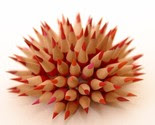
So when I ran across Jennifer Maestre's work on Etsy, I was intrigued by her use of colored pencils to create scultures and wearable pieces.

Jennifer has a website and there are interviews with her about her work. I first saw her through a Treasury on Etsy that had one of her pencil sculptures in it, and I was curious to learn more about her. See it there, in the upper right-hand corner of the Treasury?

I learned that she's using the pencils almost like beads, weaving them together in peyote stitch, to create her innovative and sculptural three-dimensional pieces. Facinating, isn't it?


In her Etsy site she has pins and focal beads for pendants made of colored pencils too, very graphic and colorful.

Aren't they marvelous? They make me smile.

Tuesday, March 24, 2009

Legendary Color Master


Instead of Tuesday Tips, this week I thought I'd pass along some news about an upcoming book that sounds very interesting! Even if you're not working in the polymer clay medium, I think this book will have color inspiration for any artist or admirer of art and be a fun read, if not a vital resource book for your art library.


Lindly Haunani and Maggie Maggio have a new book coming out, it's scheduled for August 2009, titled
"Polymer Clay Color Inspirations and Techniques."

Lindly is one of those polymer clay artists who was there in the beginning of the development of polymer clay methods and uses, coming up with ideas for how to use the new clay. She was a founding member of the National Polymer Clay Guild. Her designs and use of color is very different from mine but I have always admired her work. Anytime you see one of her pieces, it's immediately recognizable as being her work.

Her designs are always colorful and innovative, somewhat based in nature but with an unusual twist and very distinctly her own style.
Her blog is an exploration of color and a feast for the eyes. On her website she talks about her use of polymer clay and color, it's very interesting.

I haven't seen the new book yet (except for the cover), but I'm sure it will have a lot of great information and inspiration inside.


Her first book, a collaboration with Pierette Brown Ashcroft, was published in 1997, titled "Artists at Work: Polymer Clay Comes of Age." Hard to believe that was more than a decade ago now.


If you love color, shape and visual new designs and looks, check out Lindly's offerings and keep an eye out for the new book, I promise you'll be inspired.

Thursday, February 5, 2009

Privileged and Proud


Yesterday the first part of a three-part interview for the Art Bead Scene began to run.

There are folks you follow, read about in publications, follow on their blog. Admire, respect. One of those people for me is Nina Bagley.

And I was privileged to interview her for the Art Bead Scene blog. To ask her questions about her work space, how she plans, what inspires her. The things I would want to ask if she was sitting down to tea, just visiting.

Please go over to the blog and check out the interview, it runs three consecutive days.

The third part is an invitation to a discussion - I hope you'll consider participating.

Saturday, January 10, 2009

Blitz of Color - Bits of History


Legendary Jewelrymakers and the Chameleon Medium

It's clay-like in texture, but it's not ceramic clay. It's malleable but takes permanent form in an oven, not a kiln. It's colored in the package, not glazed. It doesn't break when dropped, but can be cut with a tissue blade. It comes more from the laboratory than from the earth.

It will transfer images, and can be sanded and buffed to a fine finish.

It sometimes looks smooth like china, or rough like volcanic rocks. It imitates natural stones like jade and turquoise, and can look like varnished lacquered wood or fossilized bone.


How did it get its start, what's the history of this changeling that can mimic so many other finishes and materials so successfully?


In the 1940's, Zenith Products in Illinois manufactured industrial fastener materials and coatings. Like so many things that don't turn out the way they were originally intended, it developed a material for use as a thermal transfer compound to transfer heat away from electrical transformer cores, but the material was unsuccessful and it went on the shelf.

One day a visitor to the plant, the wife of an employee, started playing with the substance and the created figurine was baked in a lab testing oven. And polymer clay was unleashed in the mid 1960's.

Because it was a completely new type of art medium, many different uses were created by people experimenting with it. Some practices used for other materials were used on it, such as metalworking, ceramics, glass and paper.


Polymer clay is soft and malleable before baking, and can be shaped and manipulated. It doesn't dry out over time, and regains its stiffness by being chilled if it is overworked. Once baked it can be carved, sanded, buffed and painted. It can have a translucence, or be totally opaque. It can be drilled, inlaid or painted.

In the beginning, some artists were creating 2-D paintings on canvas, using the clay like a paint on canvas or wood. Some artists sculpt fine figures from it, including fantasy images. Miniatures are made with it, and imitations of food that look authentic down to the tiniest detail. One original use was in dollmaking, and polymer clay is still heavily used in creating hands, feet and faces for figurines.

Two of the original innovators with polymer clay were David Forlano and Steven Ford. They started collaborating on jewelry designs in 1988, with caning, bright colors and complex patterns. They are featured in Craft In America for their innovative work.


Their creations are edgy and modern, with great shadings of color and depth.

In the beginning polymer clay work had difficulty and met with resistance for being recognized as true fine art, but Forlano and Ford helped change many minds about polymer clay and whether it could be used for serious artistic work.

Easily formed, molded and manipulated, many artists find polymer clay to be a liberating material for working out new ideas and creating new and challenging designs.


With 2008 marking 20 years of their collaboration, Forlano and Ford are still working together and making groundbreaking new visual pieces, both wearable and sculptural, and finding new ways to combine polymer clay with wood, metal and wire to make creative new images and wearables.

From the tiny mosaics created in the late 1990's at City Zen Cane to the present day, their art is continually inspirational.

And I hope you find this series on legendary jewelrymakers inspiring, click on the tag at the bottom if you haven't read all of them.

Wednesday, November 19, 2008

Legends and Renegades

This is another in the series on 'Legendary Jewelrymakers' - people who have broken new ground and opened possibilities for expression using personal ornaments as a means to tell a story.

Merrily Tompkins is a groundbreaking artist from the Northwest, a self-described Renegade Artist. She creates on paper, in three dimensions and in jewelry as a wearable art piece with a narrative story.

In an earlier post I wrote about her brother, Don Tompkins, who was also a well-known Northwest jewelry artist. Merrily was born in 1947, fourteen years after her older brother. She studied with him as her teacher in college.

It's difficult to describe Merrily Tompkin's work, there is such variety and a subtle underlying sense of humour. She works in unusual media, including matchsticks, seashells and tree boughs. Sometimes sculptural portraits made larger than life as mosaics, public art that becomes part of the landscape and miniatures that are personal ornamentation.


She creates what she describes as 'Renegade Jewelry' made to be a point of departure toward artistic expression, much less about the talisman in the objects and more about the storytelling aspect.

She was noticed first as an artist for her metal work in the early 1970s, while following the lead of her older brother Don. She took classes from her brother when he was teaching at Central Washington Universary in the 1960s.


Describing her work as multi-media, three-dimensional, figurative, narrative' art, many with moving parts, she believes that the stigma of 'art vs craft' is ebbing due to the emergence of art jewelry.

The pendant in the photo at the right:

"Slow Boat" pendant, (portrait of Ken Cory), 1976, enamel, sterling, wood, copper, brass, painted stone, pencil, lacing, Tiger Balm tin, domino

The mother of three children, she found that raising twins, three boys all together, did sidetrack her artistic productivity for a while.

Working since the early 1970's making object sculputures, metalwork and kinetic jewlery, she has a body of work that was featured at the Northwest Museum of Arts and Bulture in Spokane, WA in the spring of 2008.

Her work was also shown this year in the Renwick Gallery of the Smithsonian Institution as part of 'Ornament as Art: Avant-Garde Jewelry from the Helen Williams Drutt Collection' from March 14-July 6, 2008.

I'm sorry I wasn't able to attend that exhibit. It included a collection of 275 pieces of jewelry created between 1963 and 2001 that were compiled by Helen Williams Drutt. The Drutt Collection is part of the permanent collection of the Museum of Fine Art Houston (MFAH), an international collections of jewelry that redefines the idea of personal decoration.

The collection is currently at the Mint Museum of Craft & Design (Aug. 16, 2008 - Jan. 4, 2009) so check it out if you have an interest and you are lucky enough to be in Charlotte, North Carolina before it ends after the holidays.

Merrily Tompkins is a twice awarded National Endowment for the Arts Fellow, and the exhibit 'Down to the Nitty Gritty' at the Northwest Museum of Arts and Culture this year was the first museum exhibition of her work in thirty years.

Photo at Left:
"Thank You, Hide" pendant, 1976 - copper, brass, sterling, enamels, wood, leather and found objects 15 1/2 x 5 1/4 x 3/4 in.


There are many things that I find inspiring and interesting about Merrily Tompkins' work, but high on the list for me personally is the freedom she shows in moving from narrative jewelry with found objects to three-dimensional exhibited sculpture. She creates tongue-in-cheek works that have a message, sometimes cultural and sometimes political. But never sentimental.

Thursday, October 30, 2008

Talismans and Talents


Art, Anthrology, Travel and Craft

This is another in the ongoing series of posts about Legendary Jewelrymakers, focused on inspirational designers and creative minds who work in jewelry and physical adornment.

Photo: Gum San Journey, 1996, Silver, copper, gold, antique porcelain and leather


Ron Ho was born in Hawaii in 1936. and raised in the traditions of China by his parents, while immersed in the American contemporary lifestyle. You can see the influences of both on his art. He began making jewelry using dominos and bottlecaps, and now works in elegant shapes of silver and carved jade. He uses trinkets, artifacts, antiques and fabric to inspire thoughts of exotic locations and memories of places and times long past.

Right Photo: Dim Sum at the On-On Tea Room
Left Photo: African Safari


His jewelry was featured in Art Jewelry magazine in July 2007, where I first saw his work. I was interested in his style, and later learned that he studied under Ramona Solberg who helped him make the choice to switch from painting to jewelry in his artistic expression. He creates jewelry as storyteller, a wearable narrative, an idea I find enchanting.


Left Photo: Xian - Return to Silk Route, 2005, Carved chinese jade and fabricated beads
Right Photo: Return to Rafasthan, In Memory of Ramona Solberg, 2005, Indian jewels and gems


Ron Ho has a visual vocabulary of ethnic items but using the everyday items like chairs, birds and buttons, to express a cultural message. His first jewelry piece, 'All Fall Down' created in 1969, strongly reflects an influence of Ramona Solberg's found object jewelry. He creates tiny sculptures, wearable as jewelry.


The effects of extensive travels in Thailand, Vietname, Nepal, Indonesia and Afghanistan are apparent in his work, with a definite tribal or ethnic feeling combined with a sense of whimsey. Now located and based in the Northwest, you detect the region's influence in the eskimo ivory fishing harpoons and other icons from that culture. He incorporates items from his travels into his designs to create a story of his experiences, mixed with myth, mystery and history. The idea of artist as shaman or alchemist.


I sometimes feel that way, when I'm mixing chemicals or applying heat to metal and watching it change color and shape. It's magical. I enjoy the idea of having jewelry tell a story, or provide the first lines for the wearer to complete the story with their own ending.

Photo: Ivory Encounter, 1975, Ivory carvings with forged and fabricated silver

The article 'Tales of Migration: The Jewelry of Ron Ho' written by S. Beal, was published in the journal American Craft Vol 67, 2007, and he is included in 'Craft in America' as one of the metal artists.


He's a member of the SNAG, Society of North American Goldsmiths, and designs intricate and beautiful works using precious metals, jade, ivory and porcelain, antiques and folk art pieces.

For more information about him, check out these articles and gallery reviews at Craft in America, or the Bellevue Art Museum.

Saturday, October 11, 2008

Another Wire Legend


Alexander Calder's Jewelry in Wire on Exhibit

If you are in New York, anywhere near the Metropolitan Musuem, between Dec. 9, 2008 and March 1, 2009, you've got to check out the exhibit of Calder wire jewelry.

Alexander Calder is best known for his outdoor sculptures in bright colors, called 'stabiles'. And his kinetic, hanging metal work that he called 'mobiles' - large public art pieces.


But he also created intimate, personal pieces of jewelry for family and friends, from wire and all unique and made by hand. Over his lifetime he created more than 1,800 jewelry pieces, never mass produced, from copper, silver and brass wire. His wife Louisa inspired many pieces he gave to her as gifts, and she turned her bureau into a decorated and mysterious repository of his art gifts of jewelry to her.

He was born July 22, 1898 in Lawnton, Pennsylvania. His family was artistic and his creatvity was encouraged. He started making jewelry as a very young boy, and in Paris in 1928 he started making jewelry for the bohemians of Paris and New York.


Calder's use of wire to create the lines of jewelry inspired many other legendary jewelry artists including Lynne Merchant. He created boxes for storing his jewelry, and during the war he allowed friends to sell his jewelry for him, to help support him. Playful yet sophisticated, his jewelry was owned and worn by Georgia O'Keeffe and the wife of Joan Miro, among many others.


He didn't use solder or heat in forming his jewelry, using instead cold connections with rivets and strategically designed wire wrapping techniques. He used found objects, glass and metal, to create his inventive jewelry designs.


To learn more about him and his art there is an Oral History Interview from 1971 at the archive of the Smithsonian Institution, what better way to learn more about this iconic designer than reading his own words. He died November 11, 1976 in New York. The exhibit of his jewelry designs is side by side with a book with new photographs and examples of his drawings and the jewelry owned and worn by his notable patrons, family and other artists.

He created pins called fibulas based from ancient Roman designs, but gave them a modern new twist and an updated look. Even though the jewelry was designed and created beginning in the 1930's, it looks amazingly contemporary and sophisticated even today.

Still desired and highly sought after by collectors and museums, most of his jewelry is owned by descendants of the original recipients of the gifts because they don't easily part with them.

And the originality and creativity of the wirework continues to inspire new work by current jewelry maker artists.

Friday, September 12, 2008

Commemorative Jewelrymaker

Narrative Jewelry Disguised as Play - Don Tompkins (1933-1982)


In 1954, Don Tompkins, a twenty-one-year-old student of the influential northwest artist-teacher Russell Day, entered three pieces of jewelry in the second annual Northwest Craftsmen's Exhibition at the University of Washington's Henry Gallery in Seattle. It was the first juried exhibition he had ever entered, and his first jewelry.

He won a special award, and one of his works was reproduced on the cover of the exhibition catalogue. Using found objects, wire, photo-etched and cast items, he created a visual language that is familiar to us now, but was a strike away from the familiar when he began.


Minnesota Fats, 1971
Sterling Silver, Gold, Cultured pearl, Magazine Photo, Plexiglass
3 x 6 1/2"
The Museum of Fine Arts, Houston,
The Helen W. Druff Collection
Photo: Lynn Thompson

Tompkins was born in 1933 in Everett, Washington. His parents were lifelong teachers, mainly in small rural western schools. The Pacific Northwest has long been a fertile center for the crafts, but only relatively recently has the importance of Don Tompkins in this history been acknowledged.

At Right: Pendant, 1954
Brass and Silver
Collection of Mary Tompkins


He created charms, talismans, artifacts. He used home welders, flat irons and blow torches instead of specialized sculpture or jewelry tools. He used any machinery available, saying that the main thing is the heart and the head, not the hand. From early on, Tompkins brought found objects, non-traditional materials and experimental techniques to his jewelry, reflecting his wild native curiositity.


Pendant, 1965
Sterling silver, Semi-Precious Stones, Coin
2 3/4 x 2 1/2 x 3/9"
Collection Marilyn Whyte

A slide of the work is labeled (in Tompkins' hand), "Pendant, ca 1965." Marilyn Whyte, who luckily still has the piece, says of it, "It's probably one of the first medallion pieces. No theme to this one like his later pieces. He cast one of [his son] Paul's toy indians, wax paper, etched lettering from a newspaper somehow, added a couple of stones, a Canadian penny, and pearls."

Day says, "People like Ramona [Solberg], Ken Cory, and Bob Winston have been given credit for what was the beginning of Pop Art in American jewelry. It was Don that brought the found object to American jewelry."

Regardless of who's on first, the series Tompkins later called "Commemorative Medals," produced between 1965 and 1976, helped stake out new ground for work that fundamentally changed American jewelry making. He wasn't alone of course; it was a halcyon time, as Don and Merrily Tompkins and others, each in their own way, redefined the field.


Jack Zucker, 1972
Sterling Silver, Found Objects, Photo-Etching
Collection the Zucker Family

He began making commemorative medals using cast metal charms and other junk he found, experimenting with visual language that was totally unique. There is a record of at least 25 commemorative medals, including Minnesota Fats, Richard Nixon and Jack Zucker.

Jack Zucker (ca. 1972) is one of the gems and comes out of a terrific story. Zucker, a Philadelphia union organizer, was a friend of Betty Tompkins's parents. Along with so many intellectuals of the 1950s, he was called up before Senator Joseph McCarthy's specious Un-American Activities Committee and asked to defend himself. He said, "Senator McCarthy, I have more patriotism in my little finger than you have in your whole body."

Tompkins commemorates those words in the work, along with an etched portrait of Zucker, an American Federation of Labor pin, and a kitschy cast charm of a dancing girl, all wonderfully balanced in the grid format. A terrific tribute.

Courageous, boisterous, lusty and creative, Don Tompkins died in 1982 of a heart attack, leaving behind jewelry and images that are a lasting influence in American metalsmithing. His work looks familar to us looking back at it, which emphasizes the depth of change he brought to jewelry making.
See article here: http://www.ganoksin.com/borisat/nenam/heart-and-head.htm

This is a continuing blog post series on legendary jewelry makers, including Alexander Calder, Ramona Solberg and Amy Pfaffman - to see them all use the 'legendary jewelrymakers' label search.

Tuesday, August 19, 2008

Salvaging Sustainability - Recycled Visions


Featured Artist Amy Pfaffman

When you think of jewelry designs, you might think of pearls, silver and gold, beads and chain. When you think of 'found object' jewelry, you might conjure mental images of game pieces, skeleton keys and ceramic doll components, all of which can make interesting and unique wearable jewelry art.


But if you observe the world in an even more unique way, you could also see jewelry design opportunities in wooden rulers, computer resistors and pieces of regular No. 2 pencils.


Especially if you are Amy Pfaffman, who sees jewelry design options everywhere in the world all around her, and maintains an ethic toward recycled, sustainable and salvaged items for her jewelry inspirations.


Amy creates beautiful, distinctive and unique jewelry, with the intention to use materials in a way that recycles, salvages or makes and maintains a positive impact on the environment.

Making jewelry since 1996, her work reflects her love for functional objects and a wonderful balance and sense of design. She believes in the iconic power of the object, reasserted in a new incarnation as decorative object.


Using cold connections with sterling silver, she converts the ordinary into an ornament. Nothing is out of bounds, including guitar picks, toothbrush handles and wooden chopsticks. Would you recognize the objects in the photo on the right as sections of colorful toothbrush handles, converted into a necklace?


Based out of California, her emphasis is on recycled or sustainable materials for jewelry designs, and her work is featured here in Saint Louis at the Saint Louis Art Museum and in Kansas City, Missouri at Temple Slug. You can find a gallery listing in your area on her website.


Her jewelry art designs also have a tremendously humorous sense of fun, as she uses slices of colored pencils, pieces cut from aluminum knitting needles and groups of test tubes to create visually colorful, lovely and stimulating jewelry designs.


She takes ordinary materials and transforms them, by cutting them into smaller pieces or reorganizing them to disguise their original functions, and creates gems from everyday objects like resistors and teddy bear eyes.


Taking everyday materials, like coffee beans and alphabet pasta, she makes molds with them and casts their shapes in sterling silver to create beads that convey the original purpose of the object but converts them to lasting objects that have a different purpose. See the organic and streamlined shape of a coffee bean in the earrings in the photo to the right?

So as you walk around the house or around the block, keep your eyes and mind open to design ideas and look at things in a whole new way.

Go to Amy's website for additional information and inspiration, check out her work, you won't believe your eyes! (photos from her website at amyjewelry.com - photo credits Jack Gescheidt)

Here's a follow up question for you, if you want to post a reply or comment - what's the most unusual item you have used in your jewelry designs?